| For the full article 'Kramnik Interview: From Steinitz to Kasparov' click HERE |
 Kramnik:- I did not have the opportunity to study chess classics when I was a child. I was born in the Russian provincial town of Tuapse where chess literature was difficult to obtain. only books on modern players, such as ... Karpov, Petrosian, etc. were available. Of course, later I filled the gap in my education. However, it is much easier for me to talk about those who I met over the board, i.e. Karpov, Kasparov. Interviewer: - As you see it, should young chess players study the classics? - In my view, if you want to reach the heights, you should study the entire history of chess. I can't give any clear logical explanation for it, but I think it is absolutely essential to soak up the whole of chess history.
Smyslov plays the game how it should be played - Kramnik
 - How would you describe Smyslov? - How can I express it in the right way? ... He is truth in chess! Smyslov plays correctly, truthfully and has a natural style. By the way, why do you think he lacks that aura of mystique like Tal or Capablanca? Because Smyslov is not an actor in chess, his play is neither artistic nor fascinating. But I am fond of his style. I would recommend a study of Smyslov's games to children who... want to know how to play chess Because he plays the game how it should be played His style is the closest to some sort of 'virtual truth' in chess. He always tried to make the strongest move in each position. He has surpassed many other of the World Champions in the number of strongest moves made. As a professional, this skill impresses me. I know that spectators are more interested in flaws ... ups and downs. But from the professional standpoint, Smyslov has been underestimated. He mastered all elements of play. Smyslov was a brilliant endgame specialist. All in all his play resembled a smooth flow, like a song. When you look at his games, you have that light feeling as if... his hand is making the moves all by itself while... the man is making no effort at all - just like he was drinking coffee or reading a newspaper! This has the feel of Mozart's light touch! No stress, no effort, everything is simple yet brilliant. I like this feature of Smyslov and I am fond of his games. - Smyslov and Botvinnik played almost a hundred games against each other. Iincluding three World Championships. Did they produce high quality games in terms of modern standards? - They did, there was real quality about their games. Of course, they made mistakes since the matches were very long but... the average level of their games was very high. Sometimes they blundered but I would not say this had a strong impact on the general assessment of the play. At the same time the average strength of each move was very high. - Did Smyslov play chess like his predecessors? - No, he played differently, he had his own brand of chess. He was a master of positional play and surpassed his predecessors in this area. He was also good at opening preparation and tactics but no more than that. Smyslov did not have incredible conceptual ideas but... he was very accurate and carried out his ideas 'millimetre by millimetre'. Probably, he was the first chess player to reach the highest level of accuracy. To a certain extent, Smyslov was the pioneer of this style, which was later brilliantly developed by Karpov, i.e. the gradual mounting of positional pressure based on... the most accurate calculation of short lines. ***
Go to the official Kramnik website to see this Interview
|
10.3.11
My favorite Chess Interview! Kramink's opinion on Smyslov


9.3.11
7.3.11
T45L game, MusiquWand VS. vnchess.
A simple game.
No need for deep analysis but it’s still nice to share the basic themes of development.
[Event "ICC"]
[Site "Internet Chess Club"]
[Date "2011.03.06"]
[White "MusiqueWand"]
[Black "vnchess"]
[Result "1-0"]
[WhiteElo "2363"]
[BlackElo "2195"]
[ECO "E94"]
[Opening "King's Indian"]
[Variation "Orthodox variation"]
[TimeControl "2700+45"]
1. d4 Nf6 2. c4 g6 3. Nc3 Bg7 4. e4 d6 5. Be2 O-O 6. Nf3 e5 7. O-O exd4
![[image]](https://lh3.googleusercontent.com/blogger_img_proxy/AEn0k_sE7WpzXEvQN8sry2wa_4oTE731Euupp3QYcWS-6F7LIt1uVUHqnPfBXgxzgRIAh0g245lZ4dYrSx9T7TBZa4PCqyFKBcOzo-DXzpNwWVb9opxErK3xrxZAOKYx_8HNg7qCa3KCwzg=s0-d "[image]")
{I actually quite like these Marotzy formations! I have always found them solid and natural to play}
8. Nxd4 Re8 9. f3 c6 10. Nc2!
![[image]](https://lh3.googleusercontent.com/blogger_img_proxy/AEn0k_ty4xpsNeFx3tfnOZEqmwgBwf3P05-lTZCREwuivoZdTmmKUFnlL7cId82JNnAz10gutph6PybbGIAAZuSz-PouF6qYb5k1M7Br88LraFa55SZLpuDE0P7uRQJ2thKotveU362bcQw=s0-d "[image]")
{A modern move, White brings the Knight back but opens the file for his Queen and centre pawns to stop …d5. this move is also effective against …Nb8-a6-b4 and if needed it supports b2-b4. Black’s d-pawn is always a problem pawn in the Marotzy bind formation.}
10… Na6 11. Kh1
![[image]](https://lh3.googleusercontent.com/blogger_img_proxy/AEn0k_vrrA69XpwjTiYd5wm3dOdlSA8RIdvuHGtsGHoKvz1-Ojb0zpzvnGWFfRKG5IMiNRc4TgB5QPetqLaxMUb1_WkVrYcZSc3FD6Ds3ozdrrdXd90F_py4Sam3Qf--AelHaeS0PiEWSQ=s0-d "[image]")
{This is a prophylactic move but a good one as that! White makes sure that …Qb6 is not …Qb6+ and that makes a lot of difference! Some of White’s possible plans even include a Rg1 / g4 or Qd3 / Bd2 / Ne3. the idea of Qd3 is very rarely played and if Black allows it it’ll allow White a fantastic game. White would prefer to have his DSB on d2 because that protects the c3 Knight from Bg7xc3 and use the e3 square to post another Knight to stop future …d5. if White just plays Bd2 first the Bishop will block the Queen and …d5 may be possible. Of course the simple Bc1-e3 is more common to parry …Na6-c5 and to simply develop the Bishop out to a centralized square. Blakc would want to play …Be6 / …Nd7 but that will allow for Qxd6! Another good point for the earlier Nd4-c2.}
11… Be6 12. Be3
![[image]](https://lh3.googleusercontent.com/blogger_img_proxy/AEn0k_sVguR3CGepPUENxDQsDGLUtyL6fbJZ3-mq9qdKFk9lGFx_BCJfrrVfgRO0d7Tj8_PcLbMpKrIJ0KO36bj8JoCn5uQm0bxhCbj377NI2A8xT1K1DenCjNGc-yK15t0Hp1b3f0KC-Q=s0-d "[image]")
{Just look how White’s pieces are all beautifully centralized}
12… d5?
{Premature! That allows white to advance with e4-e5 and then f4 with a dangerous central domination.}
13. cxd5 cxd5 14. e5!
![[image]](https://lh3.googleusercontent.com/blogger_img_proxy/AEn0k_v-Y4cUolUn6-8Wo8_TmlkjCiQDxhsxpDJhlJubjEKeFeJsF5LRx0Lp5cmkJmdKBotTC0Aj0bzUVxfJSanbXgPpStv9j99EsPYPL_zrTYysjP0kcn2EB1KtGZAnMdxu2OKd-HQ_Jg=s0-d "[image]")
{Black already has an isolated pawn in the centre that in itself is a weakness. White gains more space, dislodges black’s Knight and introduces a new threat, Nc2-d4 as well as f3-f4-f5. try to find some of the lines controlled by the Bishops that will later provide a vital tactical resource}
14… Nd7 15. f4 f6?
![[image]](https://lh3.googleusercontent.com/blogger_img_proxy/AEn0k_uSCPelvF26fxiXrNN8uIWZ0eCNdY-Y0fCjw_914N-ukzG6VWZfPvYw3-cfoiD4DmrAwyhrzOoaHjv2YXXiBHHM4Qt8-m41FrnPkcfE8AsMZJfjpxNcn06LcomQ6l5ezGk2Guf6KY0=s0-d "[image]")
{Very bad move! now Nd4 will attack the Bishop, if the Bishop stays then NxB / Qxd5 will pin the Rook and it’s pretty much game over. If the Bishop moves… well… you’ll see!}
16. Nd4 Bf7 17. e6!!
![[image]](https://lh3.googleusercontent.com/blogger_img_proxy/AEn0k_uGrBesA_YcNuVE7FqKnn-Ggswq9uOQpQNyeOyT-69PS80KxxAejwsVhNp7IbpQYcurwlHs69671RMqfPqHvr3DDCBnyNGsqkmAIPKSfQKj8xukRIOsu-OZIGU58mkj5TibsXUQsw=s0-d "[image]")
{Same plan, how cool is that! Now you can see that after Qxd5 White threatens Bxa6 and Black may find the recapture …bxa6 hard to play when the Queen will threat to capture the Rook. Of course, f4-f5 is always in the air and once White plays Rad1, positionally speaking, Black can resign.}
17… Bxe6 18. Nxe6 Rxe6 19. Qxd5
![[image]](https://lh3.googleusercontent.com/blogger_img_proxy/AEn0k_ty8ORBaghs3iT6RhRNLM7JpqmmxGIZ8JgZBa4WWaje9xeWaSoo-puCiMSk1aKqC6Sz-4DrV8jwg7CmTuOlGbqQe9cXpZmxN7WUHrc50_p8xT5FJz2oi6ivg0LbDx5mzFaCCHhQ7D4=s0-d "[image]")
{Pinning the Rook, if …Qe7?? Then Bxa6 is 1-0}
19… Nc7 20. Qb3 Kh8 21. Bg1! f5 22. Rad1! Qc8 23. Bf3!
![[image]](https://lh3.googleusercontent.com/blogger_img_proxy/AEn0k_vdBlhGB0HEa0W9Kf_f85fM8iAONn5q_CiveLSSIh1KEPyL2UpfMm_EUi1YDA1QAQcbPj4QCBOhOAvLgCqUgOzx9LcSwxQenPjLbTWJxLQVF1EzUeuOjDAvsY7cXLPCK2tKmuh38DQ=s0-d "[image]")
{White’s last 3 moves are all best moves and positionally best but not very difficult to find}
23… Rb6 24. Bxb6
![[image]](https://lh3.googleusercontent.com/blogger_img_proxy/AEn0k_uobGsI1I_NcBHJCfoTYQI_L6GatTcrfJtY3qQd2g7H9rxuxB_kZlGG8KJXqLCrMAGHNuXupNQTyo8ZlUVnkP6msjH8_odYzrfDDKhEc7wa-QE0cTNQl-1PjvXwaoxV-438ufq1WG7l=s0-d "[image]")
{Black had other plans but they more or less led to the same thing. Pressure on the b-pawn, total positional control and a2-a4-a5 and winning. I missed the threat of Qf7 but not because I didn’t see it but because I thought advancing the a-pawn is stronger. either way, both are good and decent plans.}
24… Nxb6 25. a4 Na6 26. a5 Nc5 27. Qb5 Nbd7 28. Rxd7 1-0
![[image]](https://lh3.googleusercontent.com/blogger_img_proxy/AEn0k_tEW2lndLqIpsTRO9KK603K5yFMkli1TmXWQb-D30CLx7IgJUiLy-ei-qiklQLbgqzVbCfWjUcokpCU_OvCtsDZGDcpw3dY5UUz0T_KNjcywLLnPU7Ex1cUueftrlgOGARSlsc7170=s0-d "[image]")
No need for deep analysis but it’s still nice to share the basic themes of development.
[Event "ICC"]
[Site "Internet Chess Club"]
[Date "2011.03.06"]
[White "MusiqueWand"]
[Black "vnchess"]
[Result "1-0"]
[WhiteElo "2363"]
[BlackElo "2195"]
[ECO "E94"]
[Opening "King's Indian"]
[Variation "Orthodox variation"]
[TimeControl "2700+45"]
1. d4 Nf6 2. c4 g6 3. Nc3 Bg7 4. e4 d6 5. Be2 O-O 6. Nf3 e5 7. O-O exd4
{I actually quite like these Marotzy formations! I have always found them solid and natural to play}
8. Nxd4 Re8 9. f3 c6 10. Nc2!
{A modern move, White brings the Knight back but opens the file for his Queen and centre pawns to stop …d5. this move is also effective against …Nb8-a6-b4 and if needed it supports b2-b4. Black’s d-pawn is always a problem pawn in the Marotzy bind formation.}
10… Na6 11. Kh1
{This is a prophylactic move but a good one as that! White makes sure that …Qb6 is not …Qb6+ and that makes a lot of difference! Some of White’s possible plans even include a Rg1 / g4 or Qd3 / Bd2 / Ne3. the idea of Qd3 is very rarely played and if Black allows it it’ll allow White a fantastic game. White would prefer to have his DSB on d2 because that protects the c3 Knight from Bg7xc3 and use the e3 square to post another Knight to stop future …d5. if White just plays Bd2 first the Bishop will block the Queen and …d5 may be possible. Of course the simple Bc1-e3 is more common to parry …Na6-c5 and to simply develop the Bishop out to a centralized square. Blakc would want to play …Be6 / …Nd7 but that will allow for Qxd6! Another good point for the earlier Nd4-c2.}
11… Be6 12. Be3
{Just look how White’s pieces are all beautifully centralized}
12… d5?
{Premature! That allows white to advance with e4-e5 and then f4 with a dangerous central domination.}
13. cxd5 cxd5 14. e5!
{Black already has an isolated pawn in the centre that in itself is a weakness. White gains more space, dislodges black’s Knight and introduces a new threat, Nc2-d4 as well as f3-f4-f5. try to find some of the lines controlled by the Bishops that will later provide a vital tactical resource}
14… Nd7 15. f4 f6?
{Very bad move! now Nd4 will attack the Bishop, if the Bishop stays then NxB / Qxd5 will pin the Rook and it’s pretty much game over. If the Bishop moves… well… you’ll see!}
16. Nd4 Bf7 17. e6!!
{Same plan, how cool is that! Now you can see that after Qxd5 White threatens Bxa6 and Black may find the recapture …bxa6 hard to play when the Queen will threat to capture the Rook. Of course, f4-f5 is always in the air and once White plays Rad1, positionally speaking, Black can resign.}
17… Bxe6 18. Nxe6 Rxe6 19. Qxd5
{Pinning the Rook, if …Qe7?? Then Bxa6 is 1-0}
19… Nc7 20. Qb3 Kh8 21. Bg1! f5 22. Rad1! Qc8 23. Bf3!
{White’s last 3 moves are all best moves and positionally best but not very difficult to find}
23… Rb6 24. Bxb6
{Black had other plans but they more or less led to the same thing. Pressure on the b-pawn, total positional control and a2-a4-a5 and winning. I missed the threat of Qf7 but not because I didn’t see it but because I thought advancing the a-pawn is stronger. either way, both are good and decent plans.}
24… Nxb6 25. a4 Na6 26. a5 Nc5 27. Qb5 Nbd7 28. Rxd7 1-0
6.3.11
The record, 34 blindfolded chess games!

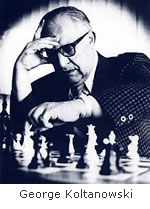
GM George Koltanowski, the legendary grandmaster of chess who wrote more than 19,000 chess columns for The San Francisco Chronicle with the same ease with which he dispatched countless opponents in a career that spanned 10 decades, died Saturday in a San Francisco hospital after a brief illness. He was 96.
Mr. Koltanowski, a gentleman of the Old World who made the world's most difficult game look easy, enjoyed introducing newcomers and children to chess as much as he enjoyed playing it.
His column, which appeared in The Chronicle every day without interruption for 52 years, was the longest-running daily chess column in history.
``Chess is an international language,'' he once said. ``Everyone in the world can understand it, appreciate it and enjoy it.''
Few, however, could understand the game as well as Mr. Koltanowski. He was an international grandmaster, one of only 200 in the world, and the former chess champion of his native Belgium.
He was also the world champion of a form of the game known as blindfold chess, in which the player commits the game to memory and does not look at the board or touch the pieces used by opponents, who play in the normal fashion. Mr. Koltanowski's 1937 feat of playing 34 opponents simultaneously while blindfolded without losing a game has never been equaled.
Known as Kolty to his legions of friends and fans, Mr. Koltanowski not only lived and breathed the game, but also cherished and enhanced it. He wrote chess books, conducted chess tournaments, coached chess players, wore chess neckties, told endless chess stories and turned the lights on and off in his Cathedral Hill apartment with chess-styled switch plates.
He preferred the brand of scotch that came in purple cloth sacks -- not because he liked that brand but because the bags could be used later to hold chess pieces.
A native of Antwerp, Mr. Koltanowski learned the game while watching his father play his older brother. He took up the game seriously at the age of 14. Three years later, he was champion of Belgium and soon gave up a fledgling career as a diamond cutter to play full time.
He competed in scores of tournaments in the 1920s, 1930s and 1940s, holding his own against the top players of the day, including former world champions Alexander Alekhine and Max Euwe, his good friend.
He served a short stint in the Belgian army, where his primary duty, he recalled with a characteristic grin, was the peeling of potatoes. While he peeled away absent-mindedly, he studied chess positions.
``Soldiers were going hungry,'' he said, ``because I was peeling the potatoes into smaller and smaller cubes.''
He even credited the game of chess with saving his life. When the Nazis overran Belgium during World War II and several of his family members perished in the Holocaust, Mr. Koltanowski was on a chess tour of Central America. He was allowed to immigrate to the United States only because a chess- playing consul in Cuba had been amazed by one of Mr. Koltanowski's demonstrations.
He came to New York City, where he met his wife, Leah, on a blind date in 1944. They moved to the Bay Area in 1947.
The following year, he began writing his daily chess column in The Chronicle. It also appeared as a syndicated feature in other papers.
``George Koltanowski was a legendary member of the Chronicle family,'' said  Managing Editor Jerry Roberts. ``He was a great chess player, an outstanding journalist, a true gentleman, and he could beat any other newspaper's chess columnist with his eyes closed.''
Every day, Mr. Koltanowski would offer readers a chess problem or puzzle and relate the moves of a recently played tournament game, along with his comments on the moves and perhaps an amusing anecdote. His chess maxims were as funny as they were profound.
``Pawns are like buttons,'' he was fond of saying. ``Lose too many and the pants fall down by themselves.''
He was assisted in every aspect of his career by Leah Koltanowski for more than 50 years, although she does not play chess and never wanted to learn.
``George is the grandmaster,'' she said. ``If he taught me the game, I'd be just another chess player.''
Managing Editor Jerry Roberts. ``He was a great chess player, an outstanding journalist, a true gentleman, and he could beat any other newspaper's chess columnist with his eyes closed.''
Every day, Mr. Koltanowski would offer readers a chess problem or puzzle and relate the moves of a recently played tournament game, along with his comments on the moves and perhaps an amusing anecdote. His chess maxims were as funny as they were profound.
``Pawns are like buttons,'' he was fond of saying. ``Lose too many and the pants fall down by themselves.''
He was assisted in every aspect of his career by Leah Koltanowski for more than 50 years, although she does not play chess and never wanted to learn.
``George is the grandmaster,'' she said. ``If he taught me the game, I'd be just another chess player.''
 Managing Editor Jerry Roberts. ``He was a great chess player, an outstanding journalist, a true gentleman, and he could beat any other newspaper's chess columnist with his eyes closed.''
Every day, Mr. Koltanowski would offer readers a chess problem or puzzle and relate the moves of a recently played tournament game, along with his comments on the moves and perhaps an amusing anecdote. His chess maxims were as funny as they were profound.
``Pawns are like buttons,'' he was fond of saying. ``Lose too many and the pants fall down by themselves.''
He was assisted in every aspect of his career by Leah Koltanowski for more than 50 years, although she does not play chess and never wanted to learn.
``George is the grandmaster,'' she said. ``If he taught me the game, I'd be just another chess player.''
Managing Editor Jerry Roberts. ``He was a great chess player, an outstanding journalist, a true gentleman, and he could beat any other newspaper's chess columnist with his eyes closed.''
Every day, Mr. Koltanowski would offer readers a chess problem or puzzle and relate the moves of a recently played tournament game, along with his comments on the moves and perhaps an amusing anecdote. His chess maxims were as funny as they were profound.
``Pawns are like buttons,'' he was fond of saying. ``Lose too many and the pants fall down by themselves.''
He was assisted in every aspect of his career by Leah Koltanowski for more than 50 years, although she does not play chess and never wanted to learn.
``George is the grandmaster,'' she said. ``If he taught me the game, I'd be just another chess player.'' Did you know?!?
History of Chess
c500 CE Chaturanga, earliest chess precursor, created in the Punjab. The Queen (or counsellor) could only move one square diagonally and the Bishop could only move two squares diagonally. The rook was called "Chariot", the Bishop was called "Elephant" and the Knight was called "Horse".
c. 600 Chaturanga reaches Persia.
c. 612 Chess reaches Europe
c. 800 Chess reaches Italy
c.820 Chess reaches Russia
c. 1000 Chess widely known throughout Europe.
1013 Chess arrives in England
1400's Queen and Bishop changed to move like they do now currently
1500's En passentadded to Pawn move, and Castling introduced. The first version of castling was two moves. Castling was changed to one move in 1561.
1886 First World Chess Championship Match. Steinitz is crowned the first World Chess Champion.
3.3.11
A 90 30 game, MusiqueWand VS. NFork, Modern Benoni
Yet another 90 30 game against the naturally talented NFork.
I was expecting NFork to play his usual Gruenfeld and prepared a nice line in the Russian variation: 1.c4 Nf6 2.d4 g6 3.Nc3 d5 4.Nf3 Bg7 5.Qb3 as played in Botvinnik – Yudovich Moscow, 1933.
It’s slightly tricky, not all that effective analytically speaking but in practical play the average White wins goes up.
In retrospect it may not be the best choice because the game can transpose to the “Game of the century” as played in: Byrne vs Robert James Fischer, Rosenwald Memorial 1956 but surely White doesn’t have to play Bg5 as White did.
Either way, NFork decided to prepare something delicious too and we ended up playing a Modern Benoni game.
Two funny facts about this game…
One, to quote Benko in his book ‘Winning with Chess Psychology’, “When you’re trying to surprise your opponent you better know for sure that it really is a surprise!!”
In this case, it was not!
My opinions about the Benoni game have been previously mentioned and I’ve also spoke about it quite harshly.
I used to play it myself and have studied it quite a lot (although that was 10 years ago) but as the saying goes: “if god was playing god against the Benoni, White would win”. I believe it was Gallagher who said that.
I have played some interesting lines against the Benoni, including the Timanov variation, modern variation, Penrose variation and off beat avoiding lines as well.
I recently won an IM in 13 moves! It was a Correspondence game and despite her tricky play the main strategy of Nf3-d2-c4 and Bf4 more or less remained the same.
I don’t believe in openings that you can’t play in Correspondence games.
I’m not against it and I’m certainly not going to refute something that has an amazing practical score but I still have a problem with it.
The game I won against Uwak with 1. d4 Nf6 2. g4 can be considered as a practical opening that wouldn’t stand a chance in Correspondence play.
As far as I’m concerned the same is true with the Benoni.
And two, somehow, don’t ask my how or why I didn’t pay much attention to the opening and played a move I didn’t want to play!
So it’s funny that in the end we were playing a MB line I had no knowledge of!
Luckily I managed to play decent moves and won the game.
I’m supposed to play a Benoni game VS. Phosphorus sometime in the future. The loser will buy a chess book to the winner – it certainly makes you more focused and hungry for the win if you actually have to pay the victor!
Right, to the game….
BTW, at the bottom of this post you will find an online interactive chess board on which you can play through the entire game without the need for a real broad!
[Event "ICC"]
[Site "Internet Chess Club"]
[Date "2011.03.03"]
[White "MusiqueWand"]
[Black "NFork"]
[Result "1-0"]
[TimeControl "5400+30"]
1. d4 Nf6 2. c4 c5
![[image]](https://lh3.googleusercontent.com/blogger_img_proxy/AEn0k_shjoQxRj2ZeIHP2mPbux-6W0ksCvzJz4QCCW1YURUgXvzLjhf8CSvU5DLM3GkAVsr0Oq9a_ow2WGlRjmn5y5YFOSgz-vE2N8ESXE0Aa99iMkluxKkTE1sFpim-ZxSIdWJP8JOMlifW=s0-d "[image]")
3. d5 e6 4. Nc3
![[image]](https://lh3.googleusercontent.com/blogger_img_proxy/AEn0k_veX9q73DM8HD0FvKwUM7xpky9xyvVFFnV5vtt8JEMwZ7ZcSycJjHl6xOj2AgURlkVmOaj4i-mYn4RNeQkIMHV-G7DsuoapTXckb04j2gZap8evyUa8JuEiaNXYQIP2sORY4OXoOOOh=s0-d "[image]")
4… exd5 5. cxd5 g6 6. Nf3
(Strange! What I meant to play was 6. e4 d6 7. Bd3 Bg7 8. Nge2![[image]](https://lh3.googleusercontent.com/blogger_img_proxy/AEn0k_tqZftvahJmuAvdVbSSwzxlNfuqD1uLINU7rwDOTDhg5mFNPNV0qZlT2Q28Cg9mDCLAsw7Xi8M1cCRNWmhT3bt-PxsUqZLoEWO8WTvzzh1fjVp4SOgPQa1Q194mZhTFbilQ6wfWAFpu=s0-d "[image]") with a very comfortable game in a Penrose style variation)
with a very comfortable game in a Penrose style variation)
6… d6 7. e4 Bg7 8. h3 O-O 9. Bd3
![[image]](https://lh3.googleusercontent.com/blogger_img_proxy/AEn0k_vOXZhQgUp-41RJGMzo0hdzF_AoHkdiluChiM30FiSROzp5IXlLHE3yLbpooISvNkb0rZTNwSj-cTfJoNQDjlaAJ95lI_Vb8LZ-RxPzFha_aBfIAdH5hRRDgQRYlfvBt35mhReq85ty=s0-d "[image]")
{This is the modern set up. So far Black hasn’t been able to prove something substantial against it. The h3-pawn prevents …Bg4 and …Ng4. White’s strategy is simple, he’ll castle King side, play Bf4 to pressure Black’s backward d-pawn and then the usual Nf3-d2-c4 and attack the d-pawn. Black can attempt …a6 / …b5 but the simple a4 takes care of that. White has classical development and a rather healthy game, the only minor problem is his somewhat weaker backward e-pawn and Black usually plays …Re8 to pressure it. It would have been to Black’s advantage if he could play …Bg4xf3 because that would deprive White from that important piece and allow Black to take advantage of the e5 square but alas, he can’t! what’s even more interesting is that regardless of strategy most lines are tactically unjustified! If you put these positions through a Rybka analysis you’ll discover that Black’s tactics don’t work!}
9… b5
{This is the normal reply. Since …a6 / …b5 requires too much time and can be held off by a4 Black wastes no time and plays …b5 but is it good? Is it a gambit? A pawn sac? A temporary tactic to win White’s centre pawn for a b-pawn? Is it Superman? Well, believe it or not White’s seemingly weaker pawn structure is actually stronger. it’s not easy for Black to take advantage of it while at the same time it’s quite easy for White to play a Knight to c4 and attack Black’s d6-pawn. In adittion, trying to chase the Knight away or gain tempo on it allows White to obtain further space control and a dangerous pawn structure. Whatever black has, seems a mere illusion.}
10. Nxb5 Nxe4?! 11. Bxe4!
![[image]](https://lh3.googleusercontent.com/blogger_img_proxy/AEn0k_ug7IrNrW7ZulzwmyBquWYoi02v8z9FD31Yhz48PZOVz3UAw_4CMRxtMrJjecfqIkT0OLqtLck8ZFgtaXtTu8iEbxHrCneQM0AnkxRvd8HZOxT-Jx3mWjdC-8_JDmNUolG18EiykZ6A=s0-d "[image]")
{Appearances can be deceiving. At best play Black may obtain a dubious, drawing position but even then his endgame is deficient and hard to play. Still, let’s consider some of Black’s ideas: first of all, he needs to regain his lost piece! Therefore the thematic reply will be 11… Re8 and indeed Black played that in the game! Rybka gives 11… Qa5+ as well. The first thing that pops to mind is …Re8 followed by …f5 but surprisingly this is incorrect! Black has to hold on to his initiative and keep the White King in the centre. a critical Benoni player would realize that whatever force is working for him it is the power of his attacking lines. for instance, the combination of …Re8 / … Ba6 / …Qa5! Is the only way for black to play for an advantage. After that he may reposition his b8-Knight to e5 and break through via …f5. this will be a nice way for Black to utilize his set up. The problem is that even then Black must play purely positional moves and accept his material loss! After …Qa5 White will have Nxd6 which attacks the Rook on e8 as well. Life isn’t easy for the Benoni player.}
11… Re8 12. Nd2!! Ba6! 13. a4! f5?
![[image]](https://lh3.googleusercontent.com/blogger_img_proxy/AEn0k_uI3yUV6lfErTMEkw_Jokyt5QwXAzwUHVt8cCGKDFCq7XKDZYgp73sOFUaHLXASLD3gJdcCZHx6oSZaMqql7lLzQ1sf8uKC8T9BhekZMCcYv_uG172fgwq0-9mNHT4OsGEZkEHlxf0=s0-d "[image]")
{As mentioned, 13… Qa5 would be better.![[image]](https://lh3.googleusercontent.com/blogger_img_proxy/AEn0k_tHBeKVMfbnb0wNg-_eMWMmlIV7OqmgC4EclCX37j4sd5MqVUM4I7KfH8htTkgcM21wcuNVN7ht0Hrr_oyOsPET2-iUZK6zMD5WuErsCu629FWCkDq0_W06iLOs5kg0cEU5gGmIjco=s0-d "[image]") After 14. Nxd6 the best Black can do is to continue with the same approach and play 14… Nd7!? And here White has many ways to play for a definite closure. 15. Nxe8 Rxe8 16. f3 is a simple one, or 15. Qf3 to support the Bishop, or 15. g4!? Or 15. f3. Black just doesn’t have enough to take advantage of White’s King. Another issue in such positions is Black’s DSB which as the game progresses seems to lose its power and attack air.}
After 14. Nxd6 the best Black can do is to continue with the same approach and play 14… Nd7!? And here White has many ways to play for a definite closure. 15. Nxe8 Rxe8 16. f3 is a simple one, or 15. Qf3 to support the Bishop, or 15. g4!? Or 15. f3. Black just doesn’t have enough to take advantage of White’s King. Another issue in such positions is Black’s DSB which as the game progresses seems to lose its power and attack air.}
14. O-O!
{Now that White gets to castle his game is a lot easier and significantly more dangerous! Rybla already gives White a winning score.}
14… fxe4 15. Nc4!
![[image]](https://lh3.googleusercontent.com/blogger_img_proxy/AEn0k_t3NUU_67ArS4Xhq_pWTRvxBF35MtRizutwo6NNzNjfx4YiQbtrg6l3-3bGdXPJnQa_xd4dQv1SqkuLPGli_qWHO3r_EdNYW1AzII6j3jyYcviBDJ8yam-pBZN27ZKxLtJa3fzQ1Jkm=s0-d "[image]")
15… Bxb5?
{There are better moves like 15… Qe7 or 15… Be5 trying to support the d-pawn.![[image]](https://lh3.googleusercontent.com/blogger_img_proxy/AEn0k_vEBSd6cThL0Wc8ZHF9FIZRL8p3lddB14Z9AHHRY5mUl0W6My6C1jw8-OxSzIKJcaTV7HzKKho5Ol8HGUkzzwakHVUI784rK5Eif59coIDmqkcLYr2MoQze65DlEPEt270v8iuYVvx4=s0-d "[image]") the problem here is seen after White’s next move.}
the problem here is seen after White’s next move.}
16. axb5
![[image]](https://lh3.googleusercontent.com/blogger_img_proxy/AEn0k_v-sVgeMlUQl_pSSq3_ZBP2yo-EtmvUCfoJ5XKlEVIOYG7fUWRIdO3sLcWB-UhpzV0KwhjGcdyQgG527Ek7N56_bt1EVNx2-TRbENgmsb-DrXqWyxNMYXieuiNXTT5wvsoy_VHOhHRlnw=s0-d "[image]")
{If White gets the opportunity to play Nc4-a5-c6 Black can simply resign because he will never be able to capture it and allow a protected passed pawn on the sixth rank! On the other hand having a Knight on the sixth is stronger than any Rook so either way Black is lost! What else? White has the semi-open a-file, that in itself is an edge but it also allows Whites to play Ra6 which protects the c6-square and attacks Black’s backward… you guest it… d-pawn! Black has development problems, he can’t develop his b8 Knight (or his a8 Rook for that matter) without losing his d-pawn to Nxd6 or Rxd6 and once that pawn falls it’ll be that much easier for White to play Re1 and Nxe4. White is also threatening the powerful Bf4 or if he can Bg5 which as it turns out strikes a massive discombobulation on black’s camp. It’s interesting to point that Black doesn’t have the time to play …Bxb2 and even if he can it’s not really important! White still has beautiful posts and strong pawns to play with.}
16… Nd7 17. Nxd6
![[image]](https://lh3.googleusercontent.com/blogger_img_proxy/AEn0k_vY-SyShOWA9PzDzVnl4Lbovz-br40MPsTNxhyLf8DVvS1O9YtrDVR13SANFpUTk8lpS5hnjB9sdEW37J2TSxTIUUzrFc-X4R7AMw927CiaMSZs1EVhYtZaP8LzlwbDUnogh-_Gk6cagQ=s0-d "[image]")
17... Re7 18. Bg5!
![[image]](https://lh3.googleusercontent.com/blogger_img_proxy/AEn0k_udBTgnoIFh9RYxLqA-yCfxYyrHO4SAUo7hZtdgDCvyzicAw55B3U45-2X7MzXMoaP1FNHEcj41nLTIApJpU3UYPkwXoUUN3TIujRDE9Ci9lWu7RA6JOOqto9KIhP3KXNLtN2x4rZiLrw=s0-d "[image]")
18… Nf6?!
{Black is hoping to for …Re7 and something takes d5 but that’s not going to happen when White can just defend that knight and keep it in place. If 18… Bf6 then 19. Be3! To attack the c-pawn and after 19… Bxb2 20. Ra6!![[image]](https://lh3.googleusercontent.com/blogger_img_proxy/AEn0k_sD1EZiZc_vnM-hzxyvWCXTSZwehn0_xmA-s16OindW9SJW2Whuhs6c7Un3DwOkS8-bMmolNN0ELCsqMt1oyb-ETXQXXxKJ6lDLH10MIZ5GqK5j-VEYM0nc7TU-DlhUSeVbUttYuPwVMQ=s0-d "[image]") It’s clear that black is in trouble with simple Qb3 or Nc4 threats.}
It’s clear that black is in trouble with simple Qb3 or Nc4 threats.}
19. Ra6 Re5 20. Bf4 1-0
![[image]](https://lh3.googleusercontent.com/blogger_img_proxy/AEn0k_v_Kmy0bkXdeA-tlOZ8WG28kd9DWSWQbPNYj6ZGEphuvRtbANpqTEnJmQXYU-IjyXEnGnmC_GnHfUCwt1OHdKVoT7NeXoUo-jAtwhe305XOXewTzvtkrtjM5hsi6BnwPI4fRKulyPyw=s0-d "[image]")
***
20. Bf4 was a nice move but according to Rybka 20. Qc1 is even better
![[image]](https://lh3.googleusercontent.com/blogger_img_proxy/AEn0k_vkOHdYM_AUk7g2a1j9xF8JtP8YwhGvwhBiqXKs8y13onr2kZYBNvMZbnXvV-tFFaw2VzlakW0lukYOi_YJ7AWvYF1afk74hKDaQcEEH4TZC4C1_y17A8M6KoM-8lMilaNbyfesGAP3Jg=s0-d "[image]")
That would prevent …h6 and open the possibility of Qc4 rather than Qb3 which is slightly better. From c4 the Queen will still attack along the a2- g8 diagonal while protecting the d- and b-pawns.
I do have one minor issue with it. White can’t play the knight back to c4 but perhaps there is no need.
***
For instance, after: 20… Re7 21. Qb3 Rd7 22. Re1
![[image]](https://lh3.googleusercontent.com/blogger_img_proxy/AEn0k_vwFvtFzyokn9sfG6T5TDWP5zidDGPWMM42mWo4yY-x2V4yZvaBfwaNQsh6aJzGfG6rlTpFCe_wBFZGcod358n1GXufEhHPPnEakTcGy_Q2_EHbNnHj3d6CtUo6z39BDY2VyvFGwt-5fw=s0-d "[image]")
The e4-pawn is threatened, there’s pressure along the a2-g8 diagonal. White can still redeploy with Bg5 and a timely Rd1 to both protect and push the pawn.
White is aggressively placed.
* to play through the game with an online digital board, see the game below.
As usual, you can find this game on my ICC library, game number 56.
I was expecting NFork to play his usual Gruenfeld and prepared a nice line in the Russian variation: 1.c4 Nf6 2.d4 g6 3.Nc3 d5 4.Nf3 Bg7 5.Qb3 as played in Botvinnik – Yudovich Moscow, 1933.
It’s slightly tricky, not all that effective analytically speaking but in practical play the average White wins goes up.
In retrospect it may not be the best choice because the game can transpose to the “Game of the century” as played in: Byrne vs Robert James Fischer, Rosenwald Memorial 1956 but surely White doesn’t have to play Bg5 as White did.
Either way, NFork decided to prepare something delicious too and we ended up playing a Modern Benoni game.
Two funny facts about this game…
One, to quote Benko in his book ‘Winning with Chess Psychology’, “When you’re trying to surprise your opponent you better know for sure that it really is a surprise!!”
In this case, it was not!
My opinions about the Benoni game have been previously mentioned and I’ve also spoke about it quite harshly.
I used to play it myself and have studied it quite a lot (although that was 10 years ago) but as the saying goes: “if god was playing god against the Benoni, White would win”. I believe it was Gallagher who said that.
I have played some interesting lines against the Benoni, including the Timanov variation, modern variation, Penrose variation and off beat avoiding lines as well.
I recently won an IM in 13 moves! It was a Correspondence game and despite her tricky play the main strategy of Nf3-d2-c4 and Bf4 more or less remained the same.
I don’t believe in openings that you can’t play in Correspondence games.
I’m not against it and I’m certainly not going to refute something that has an amazing practical score but I still have a problem with it.
The game I won against Uwak with 1. d4 Nf6 2. g4 can be considered as a practical opening that wouldn’t stand a chance in Correspondence play.
As far as I’m concerned the same is true with the Benoni.
And two, somehow, don’t ask my how or why I didn’t pay much attention to the opening and played a move I didn’t want to play!
So it’s funny that in the end we were playing a MB line I had no knowledge of!
Luckily I managed to play decent moves and won the game.
I’m supposed to play a Benoni game VS. Phosphorus sometime in the future. The loser will buy a chess book to the winner – it certainly makes you more focused and hungry for the win if you actually have to pay the victor!
Right, to the game….
BTW, at the bottom of this post you will find an online interactive chess board on which you can play through the entire game without the need for a real broad!
[Event "ICC"]
[Site "Internet Chess Club"]
[Date "2011.03.03"]
[White "MusiqueWand"]
[Black "NFork"]
[Result "1-0"]
[TimeControl "5400+30"]
1. d4 Nf6 2. c4 c5
3. d5 e6 4. Nc3
4… exd5 5. cxd5 g6 6. Nf3
(Strange! What I meant to play was 6. e4 d6 7. Bd3 Bg7 8. Nge2
with a very comfortable game in a Penrose style variation)6… d6 7. e4 Bg7 8. h3 O-O 9. Bd3
{This is the modern set up. So far Black hasn’t been able to prove something substantial against it. The h3-pawn prevents …Bg4 and …Ng4. White’s strategy is simple, he’ll castle King side, play Bf4 to pressure Black’s backward d-pawn and then the usual Nf3-d2-c4 and attack the d-pawn. Black can attempt …a6 / …b5 but the simple a4 takes care of that. White has classical development and a rather healthy game, the only minor problem is his somewhat weaker backward e-pawn and Black usually plays …Re8 to pressure it. It would have been to Black’s advantage if he could play …Bg4xf3 because that would deprive White from that important piece and allow Black to take advantage of the e5 square but alas, he can’t! what’s even more interesting is that regardless of strategy most lines are tactically unjustified! If you put these positions through a Rybka analysis you’ll discover that Black’s tactics don’t work!}
9… b5
{This is the normal reply. Since …a6 / …b5 requires too much time and can be held off by a4 Black wastes no time and plays …b5 but is it good? Is it a gambit? A pawn sac? A temporary tactic to win White’s centre pawn for a b-pawn? Is it Superman? Well, believe it or not White’s seemingly weaker pawn structure is actually stronger. it’s not easy for Black to take advantage of it while at the same time it’s quite easy for White to play a Knight to c4 and attack Black’s d6-pawn. In adittion, trying to chase the Knight away or gain tempo on it allows White to obtain further space control and a dangerous pawn structure. Whatever black has, seems a mere illusion.}
10. Nxb5 Nxe4?! 11. Bxe4!
{Appearances can be deceiving. At best play Black may obtain a dubious, drawing position but even then his endgame is deficient and hard to play. Still, let’s consider some of Black’s ideas: first of all, he needs to regain his lost piece! Therefore the thematic reply will be 11… Re8 and indeed Black played that in the game! Rybka gives 11… Qa5+ as well. The first thing that pops to mind is …Re8 followed by …f5 but surprisingly this is incorrect! Black has to hold on to his initiative and keep the White King in the centre. a critical Benoni player would realize that whatever force is working for him it is the power of his attacking lines. for instance, the combination of …Re8 / … Ba6 / …Qa5! Is the only way for black to play for an advantage. After that he may reposition his b8-Knight to e5 and break through via …f5. this will be a nice way for Black to utilize his set up. The problem is that even then Black must play purely positional moves and accept his material loss! After …Qa5 White will have Nxd6 which attacks the Rook on e8 as well. Life isn’t easy for the Benoni player.}
11… Re8 12. Nd2!! Ba6! 13. a4! f5?
{As mentioned, 13… Qa5 would be better.
After 14. Nxd6 the best Black can do is to continue with the same approach and play 14… Nd7!? And here White has many ways to play for a definite closure. 15. Nxe8 Rxe8 16. f3 is a simple one, or 15. Qf3 to support the Bishop, or 15. g4!? Or 15. f3. Black just doesn’t have enough to take advantage of White’s King. Another issue in such positions is Black’s DSB which as the game progresses seems to lose its power and attack air.}14. O-O!
{Now that White gets to castle his game is a lot easier and significantly more dangerous! Rybla already gives White a winning score.}
14… fxe4 15. Nc4!
15… Bxb5?
{There are better moves like 15… Qe7 or 15… Be5 trying to support the d-pawn.
the problem here is seen after White’s next move.}16. axb5
{If White gets the opportunity to play Nc4-a5-c6 Black can simply resign because he will never be able to capture it and allow a protected passed pawn on the sixth rank! On the other hand having a Knight on the sixth is stronger than any Rook so either way Black is lost! What else? White has the semi-open a-file, that in itself is an edge but it also allows Whites to play Ra6 which protects the c6-square and attacks Black’s backward… you guest it… d-pawn! Black has development problems, he can’t develop his b8 Knight (or his a8 Rook for that matter) without losing his d-pawn to Nxd6 or Rxd6 and once that pawn falls it’ll be that much easier for White to play Re1 and Nxe4. White is also threatening the powerful Bf4 or if he can Bg5 which as it turns out strikes a massive discombobulation on black’s camp. It’s interesting to point that Black doesn’t have the time to play …Bxb2 and even if he can it’s not really important! White still has beautiful posts and strong pawns to play with.}
16… Nd7 17. Nxd6
17... Re7 18. Bg5!
18… Nf6?!
{Black is hoping to for …Re7 and something takes d5 but that’s not going to happen when White can just defend that knight and keep it in place. If 18… Bf6 then 19. Be3! To attack the c-pawn and after 19… Bxb2 20. Ra6!
It’s clear that black is in trouble with simple Qb3 or Nc4 threats.}19. Ra6 Re5 20. Bf4 1-0
***
20. Bf4 was a nice move but according to Rybka 20. Qc1 is even better
That would prevent …h6 and open the possibility of Qc4 rather than Qb3 which is slightly better. From c4 the Queen will still attack along the a2- g8 diagonal while protecting the d- and b-pawns.
I do have one minor issue with it. White can’t play the knight back to c4 but perhaps there is no need.
***
For instance, after: 20… Re7 21. Qb3 Rd7 22. Re1
The e4-pawn is threatened, there’s pressure along the a2-g8 diagonal. White can still redeploy with Bg5 and a timely Rd1 to both protect and push the pawn.
White is aggressively placed.
* to play through the game with an online digital board, see the game below.
As usual, you can find this game on my ICC library, game number 56.
Play chess online
Subscribe to:
Posts (Atom)