skip to main |
skip to sidebar
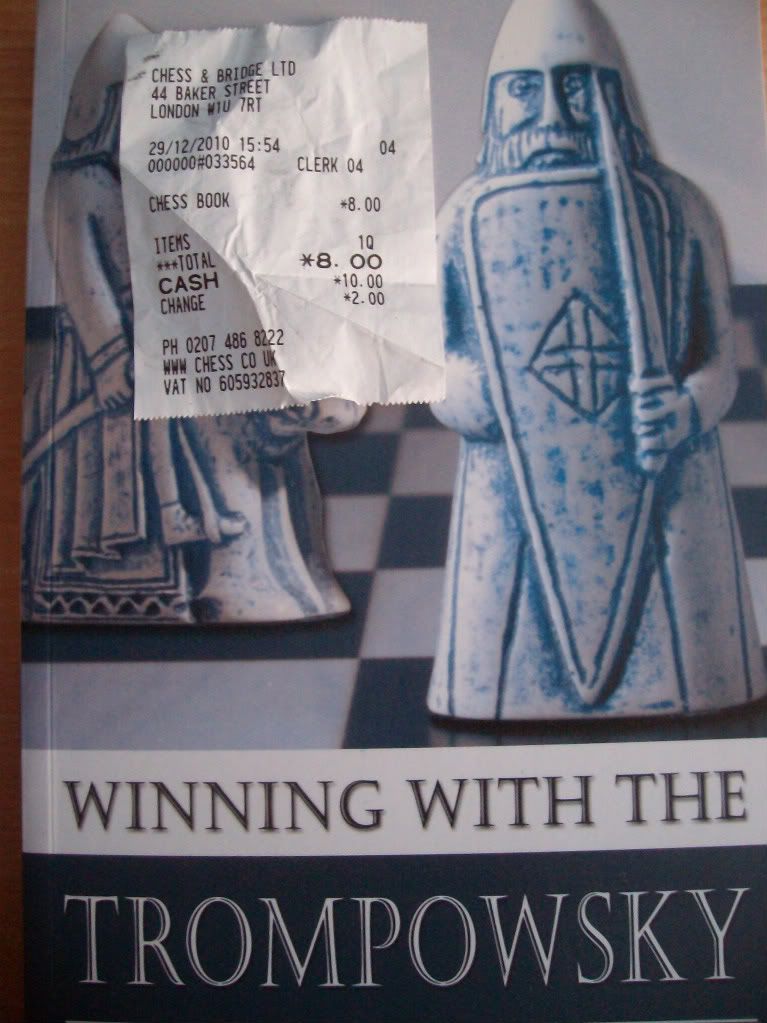
Winning with the Trompowsky has become something every book hunter treasures close to his chest.
Grand forums and sleepless hunters have been trying to find one with a locate-steady-charge attitude.
Internet prices are vaguely found if you're willing to pay no less than a few hundred dollars. What?? Are you having a laugh?? Nay! No fake smiles, it's not funny!
So I was looking over the many shelves of chess book at the London Chess Centre and nonchalantly asked the clerk about it.
"Oh, yes. We just happened to find an old box with a few copies" He said without so much as a sigh or a smile.
"Gulp gulp.... sheezee weezeee What!?" I said.
"You are going to sell me one right!!?" I demanded.
"For cheap" I added with a smile.
* Now, the people at the LCC are no fools, they KNOW of the book true market value but to quote the tall clerk: "Oh, no, we're not like that. We'll sell it to you for cheap".
"Nyam Nyam" I murmured.
They had to bring the box from the previous store's location. so I gave them my mobile phone number and awaited the call.
The next day I got the call telling me I have a saved copy at the main store.
"For how much" I asked.
"Oh, for eight pounds" He said.
Yamma hamma!
 The book, with the receipt to prove it.
Sometimes this world is just odd!
Moral of the story: Good people do exist and if you want to find them... look inside book stores.
The book, with the receipt to prove it.
Sometimes this world is just odd!
Moral of the story: Good people do exist and if you want to find them... look inside book stores.
The End!
[for the record, I did get Brian’s permission to publish this]

A Short story on Chaos and the rest. By (yours truly) MusiqueWand.
Page 1:
Once upon a time, there was a mighty beast that cared not for the rules of men.
As it were, or so does the legend tell. It did not even know its own name.
The beast walked the earth, taking prey of those in its path without courtesy or respect for this great earth’s elders and their wisdom of ancient past.
The ancient pilgrims of the west called it “The Crazy Mohican”. Then for years it was called “The Jolly Vulture”. But of course there was hardly any joy left in its footsteps.
As the beast grew older so did its taste. It no longer desired the elegant flavor of the aristocrats ( a flavor it savored in it youth ) or that of wild roosted elephants. After fifty-five cycles, the beast developed a peculiar taste for anything but the main course. Had you offered it a steak with roasted yams, it would indulge itself on the marble plate! Leaving the steak relatively unharmed. Had you offered it a King’s meal, seven courses and the best palace-wine… it would catch a near by raccoon and bite down on the poor thing’s claws setting the little figure dismembered and limping.
As the years grew stronger, the people of centre-earth had forgotten about the beast. Their well-armed tribes and the elder’s wisdom kept them on their right path and they have become simpler and wiser.
It was a small boy who first claimed to have witnessed its return from the deep sea.
As the elders drew sand pictures for the tribe to familiarize themselves with the uncommon limbs of their enemy, the small boy gulped and said: “Great Chewbacca?! What on earth is that thing!!?”. And so, from that day onwards the beast has been known as The Great Chewbacca!
As a lad the boy learned from the great tribe teachers how best to defend while using the surroundings to his own advantage. The great teacher and prophet, Nimzonitepost had taught him how never to allow what you cannot claim back. While the elder Tarraschzugline taught him, where best to strike. And no doubt his own father Watsonstrict made sure he understood his teachers well indeed.
When the boy grew into a man, on his way to become a respected elder, he remembered the teachings of the sages and knew in his heart that should the day come he will know how to hold his ground against The Great Chewbacca. Using the utmost of the skills, he gathered over time, he would use his surroundings as the beast unleashes its ferocious power blow.
Page 2:
How to con a con man. By (yours truly) MusiqueWand.
As the boy grew older and became the head elder, he recalled in bravery his tribe’s wars.
“Oh yes” he tiredly told his grandson.
“I remember the great Wall war against the BarBrians (an ancient tribe that used to throw rocks while hiding behind a big wall and wound their victims before spearing them with animal claws), yes, that was a war to remember” he then murmured to himself.
I remember very well how we finally put The Great Chewbacca to rest.” He explained.
“None could match its size and strange limbs,” he continued. “So we slowly cornered it
onto an ancient wall that the BarBrians left behind and drew holes in the ground watching the great beast falling by its own measure”. He said.
And so comes an end to our story of bravery and simple morals.
Those being:
1) Never forget what you once knew!
2) Never try to open a door from the wrong side. Dude, it doesn’t work!
3) Never eat a Gorilla when you’re being offered a juicy steak
4) Never con a con man
5) And of course never ever trust a fart! (Jack Nicholson. strategic purpose – irrelevant)
(ICC chat) To quote:
MusiqueWand: i've seen some of your games. very impressive
MusiqueWand: i still don't see what black can do after the lines i showed you
B-Wall: Joel Johnson has some in Formation Attacks
B-Wall: and in the future Formation Attack 2
B-Wall: also Horse Laffs
B-Wall: How To Play Chess Like An Animal
B-Wall: UnorthodoxChessopenings second edition
B-Wall: We are at opposite ends of the Fishing Pole spectrum
MusiqueWand: ?
B-Wall: I am interested in all of the lovely tactics it generates, you are interested in computer refutations
MusiqueWand: actually, it's not a computer.
B-Wall: You want to spend as little time as possible refuting it, I want to spend as much time as possible exploring all the different grottos and caves
MusiqueWand: the computer likes h3 not d4
B-Wall: Also the Fishing Pole attack is as old as Greco and is used by almost every world champion in different forms from many different openings
MusiqueWand: i understand what you're saying. but... if there's a system the ends it. refutes it etc. then what will you do once people start playing it?
B-Wall: I just wrote in the Irish Chess Journal about a very early Fishing Pole in the 1834 McDonnell-Labourdonnais match
B-Wall: there were at least 10 Fishing Pole attacks in the Olympiad in Khanty-Mansiysk
B-Wall: so I am interested in all the different situations and different tactical motifs that can be applied to virtually every opening.
B-Wall: I tuaght the Fishing Pole to 9 yr old Tyler Hughes who became the 2008 US Junior Champion
B-Wall: so for me there's a lot to learn there
MusiqueWand: i feel that you're missing my question
B-Wall: in the future all Ruy Lopez books will give lines against the Fishing Pole
B-Wall: but for now, only 11 years into it, everyone seems highly confused and they find 10 billion new ways to get mated
B-Wall: I consider it dancing on the edge of a volcano
It goes on and on… probably for about 40 minutes (I’m not joking) he just kept talking on and on. Most of the time I had difficulties following or even understanding what he’s saying. In fact I was slightly shocked. Didn’t know why I’m being attacked like this. After all, despite being slightly crazy I am a very polite person.
B-Wall: you can buy a car because Motortrend Magazine tells you to, you can play an openings because a GM tells you to, you can participate in an arranged marriage
MusiqueWand: not if you can refute them with simple moves. many people may love to play 1.g4 2. f4 but Qh4# is somewhat of a problem for them =]
B-Wall: or you can drive what you want, **** who you want and play the openings you create or like for yourself
B-Wall: it's about freedom and creativity
B-Wall: I played f3-g4
B-Wall: Pete Karaginis said it was the funniest thing I ever did
B-Wall: I called it an intervention because the guy sitting next to me, Josh Bloomer, was studying openings to much
B-Wall: I called it the two move Chesckmate opening
B-Wall: luckily he didn't touch his e-pawn right away
B-Wall: In Colorado I have been playing people 500 points below me so long I need to get my jollies any way I can
B-Wall: It's from living with Life Master Jack Young who invented hundreds of new openings
B-Wall: we were Life Masters who couldn't be world Champions so we played and invented new stuff
B-Wall: that we could do
B-Wall: I have played every legal move (40 ) in slow rated Chess
Hard to keep up with the topic I know!
I copy-pasted the chat, it’s 19 pages long and I said less than 10 sentences. Impressive speed-writing by the B-man!
B-Wall: You haven't said anything new
B-Wall: I feel like a French Chef arguing with someone who eats at McDonald's
Say what!!! That does it… that’s just… no one… never…. No … I don’t eat at bloody Mc- #%$# -Donald’s!!
Dude! That means war! 
B-Wall: Aronian used a Fishing pole attack in Khanty-Mansiysk, so did his female teammate, so did his girlfriend
Hooooffff, this guy doesn’t quit!
(I am having laugh I surely hope you all get that!! Because even Brian did.)
* I offered him to play a game which he quite effectively ignored for about 40 minutes until I had to get out of my normal polite manner and told him that he will probably lose. Luckily, he didn’t want any of that rubbish and agreed to a 45 45 game. Since he doesn’t play standard games on ICC he never established a standard rating and has the default 1400 rating.
White: Yours truly
Black: The Great Chewbacca (A.K.A – Brian Wall)
[Event "ICC"]
[Site "Internet Chess Club"]
[Date "2011.01.09"]
[White "MusiqueWand"]
[Black "B-Wall"]
[Result "1-0"]
[WhiteElo "2349"]
[BlackElo "1400"]
[ECO "C65"]
[Opening "Ruy Lopez"]
[Variation "Berlin defense, 4.O-O"]
[TimeControl "2700+45"]
1. e4 e5 2. Nf3 Nc6 3. Bb5 Nf6 4. O-O Ng4
( The Fishing Pole! )

![[image]](https://lh3.googleusercontent.com/blogger_img_proxy/AEn0k_uudanH6GaLQzo3LbYfYLutcJJE5PHkcy_ULx_OlY33GeQDGl5ruszO3qrSJ0c5Qn9Kykazt5jIjO3SiJFLHIk045vhDyhlBOKoVmN7W5LWfIE0yArKRKdf6pQk5lzbCL7ZkQufiukdttGAgrbwDg=s0-d "[image]")
![[image]](https://lh3.googleusercontent.com/blogger_img_proxy/AEn0k_tOPU5SwM5gX0gsxUmLSe-StKxjjFopun98Z0rytZEq3ZkXHr-fydAdibtGyMbbPkCm2nDIp-rx6xEfFHE96WEt4KIUnjqh5MXYwuzrB67CpaGdTPDTb1Cx2zxt6aVWUwKTKd39DkkVcnhCT5FTKA=s0-d "[image]")
5. d4!!
( Of course, a human move. Rybka prefers 5.h3 h5 6.d3 a6 7.Bxc6!? dxc6 8.Nbd2 Bc5 with a “purely” defense(ing) position for white. I looked into this line and I didn’t like it. It’s slow and goofy. It takes best moves, offers Black huge variety of tactical possibilities and it’s basically pure defence without strategy to back it up. )
![[image]](https://lh3.googleusercontent.com/blogger_img_proxy/AEn0k_tqP-G4543Z0jWOoX7z6APEh2kCAKVFvF3MveefNsluggV097KU1YoFFai9_q91QVQJdN8QIW0NGCs_EEKaMXS5sZYalV47dujOd1dQqdVVoak1MNk3BUpoDJZegZ9SYb9I_XY2jMWr8FYXJYYvQQ=s0-d "[image]")
5… exd4!?
( I’m not sure about this move. the whole point of 5.d4 was to one, meet a wing attack with a centre one and two, without a pawn on e5 White can develop his DSB to f4 from which it defends h2 and attacks along the e5-c7 diagonal. It also frees up the e5 squares so White has his own e4-e5! Blow – that in part is what makes Black’s game less than effective since attacking tries like …Bd6 or …d6 are met with e4-e5 / Re1. and in addition to all that should Black play …Bc5 his d4-g1 pressure is now blocked by his own pawn on d4. in short, the combination of Bf4 with the possibility of e4-e5 allows White to safely play the capture hxg4. Simple strategy. )
![[image]](https://lh3.googleusercontent.com/blogger_img_proxy/AEn0k_vtQzLiOYY7gg0jdF1l_CM-N-JkSB1FEK3JcUaY7VyTJOsvlCWyNvahPAmsMAUFNHDjcm8NRNCDhQYonP4HDMx6ao9TovzR1Purpv6FjIKcvbeuCY783VSQhCY3UnHRvnUe14y3QFyZ3AEEmNDzoQ=s0-d "[image]")
6. h3 h5 7. Bf4! Bc5!?!
( As I explained, I find this move rather optimistic and dubious. White has a lot of play and may even attack this “badly posted piece” via Nb1-d2-b3. )
![[image]](https://lh3.googleusercontent.com/blogger_img_proxy/AEn0k_v00lNOmzIy661DhygGFP_iIpkUxa2ouZDpOXg8iQ1ymtf0OcEOp6oOEfp_cWHwONgbiga4AQi6gCQYOfHf2kvn9G8JxQXipFXILmH6-r0udwWpIUtgQ3ctyLk-FyJXzpoUYtPwgrD07U2dvj-m9g=s0-d "[image]")
8. hxg4!
( Rybka suggests 8. c3 here! With some intriguing ideas like Qa4!? Or Qc2. But I think that hxg4 is the point behind White’s strategic ideas )
8… hxg4 9. Nh2 d6!!?
( …Qh4 is met by Bg3, …a6 is met by Ba4 or even Be2 – I see no reason to help black to open the diagonal for his LSB, …g5 is met by Bg3. )
10. Nd2!
( Conning the con man! I took a few minutes with this move although I already knew I’ll play it. This is something I tend to do these days for two reasons. One, it’s always good to sit back and look at the position again with fresh eyes. You might find something you missed before. And two, I call this psychological play “doing the David Bronsteing on you”. I know what position I want to reach but I don’t want to flash play my way into it. That may cause him to change gears. )
![[image]](https://lh3.googleusercontent.com/blogger_img_proxy/AEn0k_uMobP5S9qxW29a6QRPwr41rC6-BSTdmd9gIwmziVLVIjpHouUkQLSXSnpMp3FU4RZlt6h_2ZeXTe368ltjS3rQpZAm7T1dLpMtdl2bZpRF3rBOnFdkV3kZwITHl9M2IDlZ7yZrZOmRUcg28B_fKQ=s0-d "[image]")
10… Qf6 11. Bg3! Bd7!? 12. Bxc6
( This is not something you’d play right away but if you think about it, it does make sense. If … Bxc6 then the g-pawn drops and with it Black’s attack. If …bxc6 his pawn structure looks rather weak and his entire position like Swiss cheese. Moreover, of course, without the knight suddenly e4-e5 seems more than appealing! Mind you that his two Bishops are hypothetically strong but with that d4-pawn blocking his c5 Bishop he basically has only one participating Bishop and it too is currently playing a defensive role. Yamma hamma, is that all that Black can do? e4-e5 and Re1 are coming and coming fast. )
![[image]](https://lh3.googleusercontent.com/blogger_img_proxy/AEn0k_vdLY1bPMuSDAi7wEVuu4Do5QW_Qik3ktsJ2WmNi_K30iZ-E7Wd6wBdIeVZhnzDDu3PiQrkJ4JOd2HmHQigOaluO5B-ZDrQMr6cKW0Gm-S2KoFpFbdgCH_tIhHocK7EWp_8ia9a6nSKdQW5pRkhaw=s0-d "[image]")
12… bxc6 13. e5!
( Don’t know if there’s anything to be said really. Purely thematic. But sure… here’s some explanatory lines for you =D … I’m addicted. )
![[image]](https://lh3.googleusercontent.com/blogger_img_proxy/AEn0k_szoNjq2mH9XqkNQK9cW3Jipj3-VFfaIymj5t94xrb8xp7AlN2DbY-MS-Zoe3DqBg29ejyH8nBwN1gx0_1m7o_PdqdQmmPQbwJ-s-fXAuYhrUDI96MWaeQUkxtvLJ-n_q1ER3g7n4nIbgoNL9UJjQ=s0-d "[image]")
13… Qg6 14. exd6 Bxd6 15. Re1+
( Black is faced with a hard question. He is under a lot of pressure. If he blocks the check with …Be6 then, alas, the g-pawn falls to Qxg4! So here Black chose a concession, he moved his King which doesn’t help his piece coordination but may have been the best practical choice. )
15…Kf8
( After that I saw some interesting ideas both to liquidate to a more technical win and for attack. With Qe2 White is threatening Qe7+ / xd7 and Qd3 to exchange Queens. After that White can trade off the BSB and have a decent game. While I was considering these lines I suddenly realized how powerful it will be to play Ne4. Clearly the affects of spending so much time playing over Tal’s games. White is adding another piece to his central domination and threatens Black’s DSB. At this point should Black play BxB Nxg3 will not only regroup to the King side but will also cover/protect the h1 square!! That, quite effectively, will end any and all Black attempts to execute an attack. )
![[image]](https://lh3.googleusercontent.com/blogger_img_proxy/AEn0k_t8_9FHKj5lLcBPmkseTPnnXnI9jO1wX_TfFbfxtDjUOnrJfwdQznZokCE_iVvn4MwJDdNhjERE274RvNIvDns3d-gMO5atlhOnxS131ayo24NJzhEidROirYR9g2F_MD3PZPHbc0PzLn7KkApmAA=s0-d "[image]")
16. Ne4 Bxg3 17. Nxg3
( White got what he wanted, the h1 square is protected, should Black play …Qh2+ White will answer it with Kf1 and it will be the end of the attack. The Black g-pawn seems weak and so does his centre pawns. With a powerful Rook on the e-file and a misplaced Black King I think it’s safe to say that Black has nothing. )
![[image]](https://lh3.googleusercontent.com/blogger_img_proxy/AEn0k_sFtD5g68C_g-OL_w8MeF3ho33gAegrV5IhtLtbClPRSSfOWnT3GIgB4wTBRnJPheVy4dPbuMWkKFzX7opuxyqljRLm2txLgUvZFZgtR0K0e-50kbfrjC-lV-tsuKoeGtOELBGrlg4lkSNSStTTREU=s0-d "[image]")
17… Qh6 18. Nxg4 Qh4!!? 19. Ne5!
( It’s hard to say, perhaps 19. Re4! is even stronger. )
19… Be6
( This is an unfortunate stage of the game, as far as I’m concerned. I’m sure that many players will say that it IS the reason to play a crazy attacking line to begin with. be is at as it may I think that an unsound game is an unsound game weather you’re winning or losing it makes no difference in an analytical terminology. I was starting to get into time trouble. Now, that is not something uncommon for me. I am a notoriously slow thinker. But the last few months I seem to think a lot more than I used to. It certainly did wonderful things to my rating! But, I had to adjust to practical games by finding new ways to handle the clock. So basically once I reach my red-alert TC I try to think at least the amount of my increment and/or the amount of forced moves that I can see in relation to the increment. Meaning. If I see 3 forced moves (so I know I’ll get 45 seconds from each of them) I try to think for about a minute and a half and then regain that lost time by playing into the variation. That seems to work well. Still, I don’t want to find myself in a situation where I HAVE to use a few minutes to figure out where I am and what to do and by the time I do to find myself playing a Blitz game against my opponents 48 minutes. That will just be bad time management – even on ICC! Until this point I believe I played good if not best moves! At this point that starts to change. Luckily, I was still able to find interesting and tactical ways to parry his own! The lines I saw were the Queen going to f3 and then the Knight can go to g6 with a triple attack and I can sacrifice a rook with Rxe6. it’s not the best plan but it works okay. At least for you, viewers, it’ll become a bit like solving trainingBot problems from this point on! The best move however was Nf3! That would put another defender on the King side, attack the Black Queen and guard the h2 square. After that, Black has nothing. Instead, I played my less effective but still decent combination. )
[You can see that at this point I’m quite behind on the clock]
![[image]](https://lh3.googleusercontent.com/blogger_img_proxy/AEn0k_t8XQpWvfNLwP04Rp-pFBEyt_DrCcVcVmsDiaOuEKAmPw_jzI76jSd9LiQsRDXTErb79h_W4a--W9IFYKGNZnIoqf1bEhdAR9FSwMjwNBlsltOtw8mJd7gpFL0RKe0uYiHj8EmF3D6DTP1zPTLwXg=s0-d "[image]")
20. Qf3!?
![[image]](https://lh3.googleusercontent.com/blogger_img_proxy/AEn0k_vvHtQRPBOxwCu3RCYLEFh11OgotVNb47R1I4t_rF4ytlTA6iH0AZ5HjHJfHVFm4nrSFQ_HiSKOaUDfMO8S6eURa9-wkTx8unL9VdkAUOtNO1PBi1d7UuAUst_OGYHe4IpNfV3cUBo9m-YbVDOf2ZU=s0-d "[image]")
20… Qh2+ 21. Kf1 Re8
( here it is. At this point I should of played Qxc6, picking up some material and then Rad1 and win the game. Rybka gives Qxc6 a score of +4.30 )
![[image]](https://lh3.googleusercontent.com/blogger_img_proxy/AEn0k_tijGW8fHQ-ydvL0F1uSJ3hQD_z8zbm3X7fbPLGVAzg_tqIjF0QQOVsM5wlOrT3PERx8yt2uq_qxSbE51ZyUc3Fae_Om-X-24PVUDGcXU1XkjnF1hMnhPo-vKU5KBK7zLu62gNSMdNlxH9dojk5EYs=s0-d "[image]")
22. Ng6+!? Kg8 23. Rxe6!
[Quite a TrainingBot mate exercise isn’t it?? =D]
![[image]](https://lh3.googleusercontent.com/blogger_img_proxy/AEn0k_sm6YHf-YFe5VRn5z1QbXXWzSTX-QFAInFrvSglGRk3nvCpEGXQnW-V-JRmLQ9s987W46BNmCg4rSAomB3xMViMh8Weqz2I8SuH0rSQrJf2pC3t3ECK4vDJndISDZqj_-gQhCfaJwcqaRQwulBTH1E=s0-d "[image]")
23… Qh1+!! 24. Nxh1 Rxh1+ 25. Ke2 Rxe6+ 26. Kd2 Rxa1 27. Nf4
![[image]](https://lh3.googleusercontent.com/blogger_img_proxy/AEn0k_tK7thDniACI27QHEZBwNXAHQPgcdRBSisRfenSpY5dfTeyZDEnKP4gti4gr2LGtFAyu6DCmfmPKaMQzLVbvGle9w9eO7LoGrjUQRuNJVERf4IgMmEMTNysInitezdS6wH2mo58zronRhxH4kDZ_Q=s0-d "[image]")
27… Rf6 28. g3 Rxa2 29. Qb3 Ra1 30. Qb8+ Kh7 31. Qxc7 a5 32. Qd8
![[image]](https://lh3.googleusercontent.com/blogger_img_proxy/AEn0k_tsEng8vi_P9SNc5qxM1O1TYmPHJwkMdn8uLX00fYHFwMxLJwvct-8_m9o5fZox7xfVMq6FdYfWII3LzyfmsZGn2DFC368mqN5LGFvSa-iJDQ2IhqlWgdV7Ahyt8d3IXA2dhFMSOyQDM54AruC2vMMCSg=s0-d "[image]")
32… a4 33. Qxd4 a3 34. Qd3+ g6 35. bxa3 Rf5 36. Qc3
![[image]](https://lh3.googleusercontent.com/blogger_img_proxy/AEn0k_sbOFMmuPIyiV4MVY13H7VXqRAvfIQMlCEZkwc2EEdy-J2o2NgT0_K5rc3P0HwikvfM_YLkM0OfCb2Mor8D9ONqOECMtDzZV_ik6DCh8u6l1pBKqUhuFXjbcYFUgmsNUbX5UGBOuFzEEph_V0Bp1Os=s0-d "[image]")
36… Ra2 37. Nd3
![[image]](https://lh3.googleusercontent.com/blogger_img_proxy/AEn0k_uSXoC65fX3HuOuI6VvHEK3bN5CGRqSGdGIrWu6of4kpJVCpfuqf9oLMmiWYbWqUvY0JaRBFwmRiSyuhgkwkv9wglFGUyM-rvjYMLoaHgXiWk6P-EY6PoKjyFjICyLzmBYxBbZqfXBkG-Ia1B-t45M=s0-d "[image]")
37… Ra5??? 38. Qxa5 1-0
And that's all I have to say about that.

As usual, you can find this game in my ICC library. Game number 35
He was very cool about losing and started to quiet down and let me do some talking too. But that didn’t last for very long… we ended up having a conversation about the KG and I said I have been analyzing it for about 9 years and so far I haven’t found a clear way to refute it. He basically laughed at that and said that everything is winning against the KG and challenged me to another dual.
Here’s the KG game:
[Event "ICC"]
[Site "Internet Chess Club"]
[Date "2011.01.10"]
[White "MusiqueWand"]
[Black "B-Wall"]
[Result "1-0"]
[WhiteElo "2349"]
[BlackElo "1400"]
[ECO "C30"]
[Opening "King's gambit"]
[TimeControl "2700+45"]
1. e4 e5 2. f4 h5?!
(Apparently this is one of Jack Young’s inventions and he named it the Raccoon because the h-pawn resembles a Raccoon’s claw.  I have never seen that before in my life. We started talking and I said that this move has to be bad (to which he laughed again) and I named some basic reasons like giving me too much of the centre and the usual Nimzovich/Tarrasch. It took me exactly 6 minutes and 47 seconds to come up with a strategy to refute it. I don’t mean to make it sound like I’m that strong, I’m not. I just listen to my teachers, very very carefully… because you know what… occasionally; they do have a bloody point! )
3. d4!!
(Rybka prefers d3 with a slower game but a more solid one as well. Dunno, I like my d4! yes d4… definitely d4. it makes more sense than a horse’s ---- any day! Why? Well, as I actually told Brian while actually playing it. It’s simple. The one thing Black does have is a massive pawn attack on the King side. But after …exd4, hey guess what happens after Nf3. ha ha, No ..g5 for you! )
3… exd4 4. Nf3 Nf6? 5. e5! Ng4!?
( My god, a bloody Fishing Pole! )
6. h3 Ne3 7. Bxe3 dxe3 8. Bc4 Bb4+ 9. Nc3 d5 10. Bxd5 c6 11. Bb3
( It might be possible to play Bxf7+ here. I’m not sure yet. )
11… Qxd1+ 12. Rxd1 Be6 13. Bxe6 fxe6 14. Ke2 Bxc3 15. bxc3 Na6 16. Rd6 Ke7 17. Rhd1 Rad8 18. Nh4 Rxd6 19. Ng6+ Ke8 20. Rxd6 Rg8 21. Rxe6+ Kd8 22. Kxe3 Nc5 23. Re7 Kc8 24. f5 Kd8 25. Kd4 Nd7 26. e6 c5+ 27. Kc4 Ne5+ 28. Kxc5 Nxg6 29. Rd7+ Kc8 30. fxg6 Rf8 31. Rxg7 Re8 32. Kd6 Rd8+ 33. Rd7 Rg8 34. g7 h4 35. e7 1-0
Now, Jack may have intended for it to be a deadly Raccoon's claw but in reality it is a baby Raccoon! 
(ICC chat) To Quote:
B-Wall: I think I’ll adopt your playing style.
=D … the end!
As usual, you can find this game in my ICC library. Game number 36
Links:
http://www.chessville.com/reviews/HowtoPlayChessLikeanAnimal.htm
http://www.lulu.com/product/paperback/formation-attacks/12922778
This is a rather unique case where I was playing my Slav-SW-system as Black against a player I knew in advance who plays the SW as white. That gave me the opportunity to play some finer nuances I could not normally play.
[Event "ICC"]
[Site "Internet Chess Club"]
[Date "2011.01.09"]
[White "eezy"]
[Black "MusiqueWand"]
[Result "0-1"]
[WhiteElo "1877"]
[BlackElo "2347"]
[ECO "D00"]
[Opening "Queen's pawn game"]
[TimeControl "2700+45"]
1. d4 d5 2. e3 c6 3. Bd3
( Noticed how White’s pawn structure prevents his DSB from pointing at the h6 square. That allows black almost exclusive opportunities both to initiate his plans in full but also to play … Nh6 straight away. And this is important why? Because Black could then follow up with Bg4! Developing his “bad” Bishop out side of the future pawn chain. )
![[image]](https://lh3.googleusercontent.com/blogger_img_proxy/AEn0k_u-q4LOR1vF9RIz8n4KAWdxqeRFCKpNgaSRzSVrOeY8EDU_ZIGDCEJkA1tFi5hSDhnNBLAVo3ZiM5xyHNDVrZE-krHbtxW4E7frg8Ipv06TzsfPWP_uM9yRNXQsR-c=s0-d "[image]")
3… Nh6!!?
( This is already untypical. For someone without any knowledge of what Black is attempting to do that will most probably appear as a beginner’s mistake, a Knight odd or plain goofing around. )
4. f4
![[image]](https://lh3.googleusercontent.com/blogger_img_proxy/AEn0k_s02Bw2RfCWk1pNCqurgy2W3OL1DvBmbl6M87zCAm1fTljzCvFzPNIjDcRjXoeOrovJJieKC1L8Pwi-MVo0GcR0CH6XHfyVzfWyKk4HwZPCJ5-abKPxOiRH33AECMjxow=s0-d "[image]")
4… Bg4! 5. Nf3
( With very strong pawn chains from b7-d5 and f7-d5 Black is already solid. After developing his LSB out side of these pawn chains, I feel I can already state that Black more or less solved all his opening problems. At move 4 no less!!?? )
![[image]](https://lh3.googleusercontent.com/blogger_img_proxy/AEn0k_vbWVFV40gUtREjKBRQ7NDUMrNOv_S1NE5zWwjSP7CD_iLlUlcALU5b_jfy1GPYlQVH8FmQYqCrOt2LmrockoSYdSLBYnk5edCLVGK4vCcNXC4bWsSjlSsjVHBhVvPvaVQ=s0-d "[image]")
4… e6 6. O-O f5
( It’s interesting to see how White’s Bishops are blocked inside his own position by his own e3 pawn and Black’s f5 pawn. Black on the other hand has two good Bishops. Is anyone thinking what I’m thinking?? That is, that Black is already better!? White may hope that Black’s early Bishop move will give him an attacking route via Qd1-b3-b7 but as you can clearly see in the diagram Black can easily defend against this rather harmless and perhaps even unpositional idea )
![[image]](https://lh3.googleusercontent.com/blogger_img_proxy/AEn0k_sJSh6DU3wJIcGzKzsdHTQ6glJBkG7zb2HFE4cub6B0SCijqlfL8O5fqWZaShFqQgVE54iSe7xKZLE6tVHm7Q386sc8rhoERg2w97Iia6YEuKJ5SkzOsmC28UqUXsu3taI=s0-d "[image]")
7. Nbd2! Nf7
( Black hurries up with … Nf7 to protect the e5 square from an early Ne5 ventures. That also strengthens his counter blow with … g5 should White make a mistake and allow it. It’s also interesting to see that 8. h3 is not forcing Black to trade his Bishop for the f3 Knight. Black can feel calm and play the Bishop to h5 and maintain both the pressure and the dynamics of his LSB )
![[image]](https://lh3.googleusercontent.com/blogger_img_proxy/AEn0k_vPzidYhiVMMaMj4ex2ZzgySF51txFl4apK6meIyq_ZZyu3jjpj8xsqc-RLGFmniRsQtqi3MAK5zs24I9AkajaICE-xGXu_TEprQ7Yw5oLL2vS3r2UJWmm5Kz3T8CnOHK4ZBg=s0-d "[image]")
8. c3!!?
( If anyone was expecting a sacrificial/tactical game… that ain’t gunna be it! No matter, both sides have obtained a bunker type pawn structure. Solid indeed. )
![[image]](https://lh3.googleusercontent.com/blogger_img_proxy/AEn0k_tyTNbmGEgobjSp6vx7jicveqBaYGW3sevE-jgBycDZ8j4BhoeY36au8memlzp9KDp_v4Yxkxubf6rsoZL1JEDyVsrH3S_72rG6wk5821kav6OEqcnJmLE6wlkbl8zei7UExQU=s0-d "[image]")
8… Nd7 9. Qb3?!
( I find this move rather dubious at best. Perhaps even a clear mistake. I don’t know where to place it though. It is not a critical mistake or even one that could be defined as strategic it is simply pointless and misses the point. the truth is that the Queen belongs on the Kings side! So I’d say that this move fail in over all game plan sort of way. Here Black has a few moves and aside from … b6 they’re all decent replies. Since I miyself wanted my queen to go to the King side I ended up playing the most boring of all moves and perhaps the one that was the least precise. Still, it was okay. )
![[image]](https://lh3.googleusercontent.com/blogger_img_proxy/AEn0k_v31vTvQwzNaa3s2jikcRqFoxrTEd4QXd1anLUx14rOB8H7PDrkY9oYauhtRYs9WEQHNnfIJ077SYgjlab3D3AJZVOi3TGfav2holx971NlQ_jYs3Jj31jIE_TW-Jbhc3c-n5W7=s0-d "[image]")
9… Rb8 10. c4! Be7
( White feels that his development has matured enough to allow for c4 or at least he felt that it was necessary. I can’t disagree, if not now then soon.
I think that … Be7 was a very good move. Keeping everything at bay, hardly committing to anything and allowing 0-0. )
![[image]](https://lh3.googleusercontent.com/blogger_img_proxy/AEn0k_uOQ-gV2LKWhH2X9Qagk17YD7pV5e391PNFNWe750Zv9zFcl1-JwgE0pj0xP5Aux1AJn_j304bxhQB7rBRdZ4ZuMkCI3QsxEvb2nnLKRgcMPfwtOrSiHglF8fnItL9u511gEHcj=s0-d "[image]")
11. cxd5 cxd5 12. Bb5 a6 13. Bxd7+ Qxd7 14. Ne5 Nxe5 15. fxe5 O-O
( Position assessment: Black is better! The e3 pawn is weak, Black has more space and greater piece-play. His Rooks are free to occupy the c-file and he is getting ready to make some noise on the King side. But what about poor White? Is he really doing so badly? Well, this might be defendable but I wouldn’t call this drawish. With careful play White can hold his ground. Rybka’s assessment: -0.60 )
![[image]](https://lh3.googleusercontent.com/blogger_img_proxy/AEn0k_tQoP1iKXXGW4dUXnJGiWDQyUGpfgTz7pzUPYtUFf0BupWOhsDE2386EUl_jBKUmexWyHtaBJ3L2nCw0aALU2ruAQt7FzH0g9GDkcx5AQragBnHUwOtXnq1ofVVhc0Xh_QCQlGvMuQ=s0-d "[image]")
16. Nf3! g5!?
( A surprising move? No I think this should be expected but apparently not the most precise at this time. Perhaps some extra preparation was needed or in compression, a simple Rook move to the c-file would have proved more useful. But with all honesty, as a human player… I like this move a lot! It sets challenges and changes gears to a King side assault. Black already has the plan of g5-g4, this will open the g-file and make way for Kh8 / Rg8 etc. )
![[image]](https://lh3.googleusercontent.com/blogger_img_proxy/AEn0k_tAY6GS_84M18h4Fnl7mqRjlH1mnsYtm8hN_UFObcpdoetVPulgDY2y5N4W-8EgcFTluAqaQm8U51Kq0BbWY7t8azmzQlm0XF2d_x4BPFeP_v73vXDyIQHlvRk3Z0Rj_0oy0Gk4XeU=s0-d "[image]")
17. Bd2 Bxf3 18. gxf3 g4! 19. Bb4!? gxf3 20. Rxf3 Kh8! 21. Bxe7 Qxe7 22. Kh1
( a word about the players: this was the first time during the game where my opponent actually started to pay closer attention and think for longer periods of time. Until that point he was having a very big time advantage. So a note to the player, don’t start thinking when you already have a losing position! Go to ICC and watch some of Heisman’s videos about time management and general ways of handling your play.
It’s hard to make suggestions from this point on because I feel that black’s ideas are easy to understand. The rook is heading to g8, the Queen to h4 and from that post White is hanging by his teeth. There are dangerous Queen paths leading to e4 from which a Rook may fall or the e3 pawn. Or even the simple threat to g2 and mate. Another nice idea is Rg8-g3. The same goes for the Queen side. Black is getting ready for … b5 and with Rf-g8 and Rb-c8 Black has almost full piece-play and full initiative. This is pretty much game over. )
![[image]](https://lh3.googleusercontent.com/blogger_img_proxy/AEn0k_vBunXtVazJIOmEFxXuczaQ1i-HhIlLmKy_Nbn2PTy2mxBbAR7NnRHR9mhw0EqYF5olbAc7ebghS2vg813NfUrDp3kzFwJ18Oa58IN9XRnvL0qEH2-OCEjlKMYowxoI4H5xtoM1zVcX8w=s0-d "[image]")
22… Qh4 23. Rf4 Qh3 24. Rf2 Rg8 25. Re1 Qh4
( The Queen is attacking both Rooks and threatens to go to e4 and the Rooks are very active. These threats are very strong and requires White to play best moves which he was certainly capable of!! If he only played that well in the opening this might have been a simple draw. )
![[image]](https://lh3.googleusercontent.com/blogger_img_proxy/AEn0k_t2K5eClrQHN6ce26DwI9IF3-nqLDc7CUhnZ8aM2G3V9DjWe7JLtuqmkgPKyDK8f2knQQj4oLpNlTnLvAnSUWnjwEAPCAHdzR5-7pdBX0N3v4uEXxGl6nNJ9d-Bd2IHBtRPOKFe8XfRviw=s0-d "[image]")
26. Qc2 Rbc8 27. Qe2 Qe4+ 28. Qf3 Qxf3+ 29. Rxf3 Rc2
( A very basic endgame theme. Rooks activity. Black controls both the c-file, g-file and b2-rank. White’s pawns on h2, e3 and b2 are all weak and about to fall. A technical endgame. )
![[image]](https://lh3.googleusercontent.com/blogger_img_proxy/AEn0k_uy1bOd48Kgj15eXO-_eHEb2thEBuZH7h4mu5d_LkUmyN0il5i2tutqQI3f_jiUlAIvcTOPIceDhgPLcnyn1pKwmZG9fEfqM7xZySc55PMj65cCxuTBe_zQLfiA2T5N_wlsfIJGANIwzdNlugQ=s0-d "[image]")
30. Rb1 Rgg2 31. Rh3 Rxb2 32. Rxb2 Rxb2 33. Rh6 Rb6 34. Kg2 Kg7 35. Rf6 Rc6 36. Kg3 b5 37. Kh4 b4 38. Kg5 a5 39. Rh6 a4 40. Rh3 b3 41. axb3 axb3 42. e4 Rb6 43. Rxb3 Rxb3 44. exf5 h6+ 45. Kf4 Rd3 46. fxe6 Rxd4+ 47. Kf5 Rh4
( The White king is in paralysis and has no squares to spare. The Black king can defend against White’s e6-e7 move but white is stuck on the f5 square and is unable to to stop the inevitable promotion of the Black d-pawn. White resigns )
![[image]](https://lh3.googleusercontent.com/blogger_img_proxy/AEn0k_sx0L54IqEVMWPFJAl9JKlqGnb36j8FmUeFXh7Bt7KEAT2LELfL507S_iXNfSHKZiDHYuAmLvifwrKu-NXicsXD-bSdbEdxm8P062j-VQa-OY3M7-w789P0GwaYqv81kEZVip23dSbBofwrKGM=s0-d "[image]")
0-1
As usual you can find this game on my ICC library, game number 34.
I had a creative spasm the other week.
I have been playing the Slav for as long as I can remember. Not exclusively but it has always been one of my favorites.
I played and lost a few games against the Stonewall these last few months. That got me both irritated an intrigued so I tried to play it myself. it’s pretty useful, doesn’t really give much and there is always …g5 lurking in the fog.
Personally I’m quite comfortable with both 1.e4 and 1.d4. but I have been playing 1.d4 more and more the last year and have enjoyed to follow many of Avrukh’s repertoire suggestions.
In his first cover he talks about the transformation of the Slav to a SW. he says it’s relatively uncommon and explains how white should handle his position inorder to secure a decent plus.
A thought came to my mind upon following his pages.
“why should black cramp himself so much?” …
To make this story short I suddenly saw this next development idea:
![[image]](https://lh3.googleusercontent.com/blogger_img_proxy/AEn0k_uqz5WOSY1mOTwbVUlZ9xzic5N7jytX66VvS4Zurl8cn9NfFSY4ofJh6nhc-2IjE72JOeNPAsd6ho7_2ow4lwf4GFyvZM3NZRBXwaAXanEgeioLqDG-dV2Ev_ZLkA=s0-d "[image]")
The idea is simple, you deploy the b8 Knight to f6 and the g8 Knight to f7. Why?
For these reasons:
A) first of all it’s sound
B) it can’t really be stopped unless white changes the game’s theme by capturing the centre which in that case the game is even more drawish than it is now.
C) With Knights on f6 and f7 Black protects both e5 from penetration of a White Knight and defends his own e4 control. But isn’t that the same case with the Knights on f6 and d7 like in the normal lines? yes, but… with this development black gains something extra. The LSB is freer, it has one more square to maneuver itself to and it over protects the e6 pawn. And second, …g5 which is the normal attacking theme of the SW is actually playable right away without the preparation of …h6 (since the Knight on f7 supports it) of course playing ..h6 / …g5 is even stronger with a Knight on f7.
D) Should Black want to play his DSB to d6 (which I’m not sure is needed in this opening format since white usually plays f4 anyway) it is now slightly better placed with the Queen guarding its post.
So, in short, it gives Black a freer position while keeping pretty much everything under control and perhaps even make the normal themes stronger.
![[image]](https://lh3.googleusercontent.com/blogger_img_proxy/AEn0k_sUpUBuXeX_TSYf3tu5xR8GWq64g3GOvaXDhEHBSqCoVXhH4CIhLldnlmsy73gOWk5psnDH3pg8uCtdJz1g3zEvBtArS60XjtAlqTqf69zKzmcQr3PaeACJkvV4o6Q=s0-d "[image]")
So far I played it 4 times, won 2 and drew 2. Not a bad score at all.
Here is a sample of the normal themes of this unusual position.
This is a game I played against my friend (on ICC) Phosphorus. He too plays the Avrukh repertoire.
[Event "ICC"]
[Site "Internet Chess Club"]
[Date "2010.12.20"]
[White "Phosphorus"]
[Black "MusiqueWand"]
[Result "0-1"]
[WhiteElo "2133"]
[BlackElo "2361"]
[ECO "D11"]
[Opening "QGD Slav"]
[Variation "3.Nf3"]
[TimeControl "5400+90"]
1. d4 d5 2. c4 c6 3. Nf3 e6 4. e3 Nd7
(It is quite reasonable to play …f5 first I just find this move slightly more cunning)
5. b3 f5 6. Bd3 Ndf6
![[image]](https://lh3.googleusercontent.com/blogger_img_proxy/AEn0k_sl5VPmvwcYaUW_31tiMOH4v1NmYK2V6BEkXFZzoLDp1nnTbUrJgwJb6o5YlorMfkZVb38Y_FIrLItWu5DfrVtLYja0cBpM8xAgalhOs5TK7iLsIZTX6jKp3sZWGTQ=s0-d "[image]")
7. O-O Nh6 8. Ba3
(a very common theme. White is opting for this strategic notion that Black should suffer later on from the disappearance of his “only good Bishop”. Honestly, I’m not so sure that it has the same effect here because as I mentioned, White usually plays f4 anyway so it would have been a “bad” Bishop either way.)
Bxa3 9. Nxa3 Qe7 10. Nc2 Nf7 11. Ne5 O-O 12. Nxf7!? Rxf7 13. f4 b6! 14. Ne1 Bb7 15. Nf3 c5!!
(Otherwise White can penetrate with c5 himself or try to open up the centre in a way that will be beneficial for him)
16. Ne5 Rff8 17. Qe2 Nd7
(maintaining the control over e5)
18. Nf3! h6!?
(sooner or later that …g5 thrust will be an option to consider)
![[image]](https://lh3.googleusercontent.com/blogger_img_proxy/AEn0k_vCi_T2iBGpRUQ1lQzyWNmRUrVSzxVBWU0UEOGj1QUcIGxBWVOwdUdRoCy2bSmJwCRKllo2mUwHRy19-0sKH8Z4bQwvTnqrnodooZSY9IXJqUTvw4R8SPWNmwXabw=s0-d "[image]")
19. Rac1 cxd4!?
(the next few moves are not best. Black had better moves but I had an interesting positional plan that at the very least was well calculated I just missed his 21.Rxc4, that was a slight inconvenience.)
20. exd4 dxc4 21. Rxc4 Qd6 22. Kh1 Bd5 23. Rc2 Rac8 24. Ne5 Nxe5 25. dxe5 Rxc2 26. Qxc2 Qb4 27. Be2 Qd4! 28. h3 g5!!
(…g5! Basically decided the game)
29. fxg5 hxg5 30. Qc1 Rf7!!? 31. Qxg5+??
(Unfortunately he fell for the tactic. The game could have been drawn after Bf3 with complications)
Rg7 32. Qd8+ Kh7 33. Bf3 Rxg2 34. Bxd5 Rg7 0-1
As usual you can find this game in my ICC library. Game number 28.